




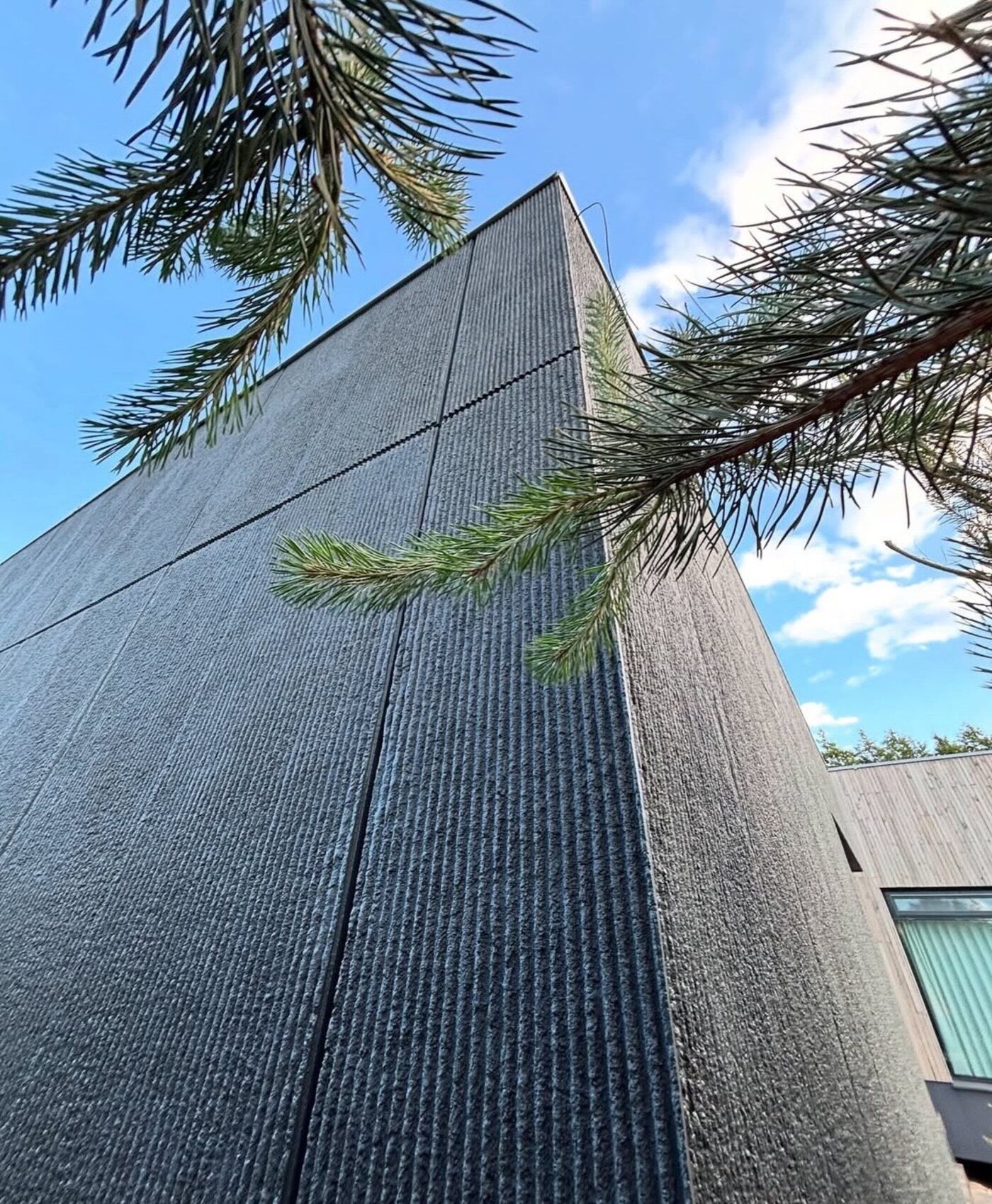
We explain what PHOMI is made of, why it is manufactured differently from ceramics and what that changes for designers and builders.
A wall that looks like natural stone does not have to be made of slabs cut from quarried rock. A façade that resembles concrete need not be cast in concrete, and a brick pattern does not always mean brickwork. One way of creating such surfaces is MCM, or Modified Clay Material – a thin, flexible cladding made from processed minerals.
PHOMI makes its MCM using its own econiclay technology. The idea is not to replace stone purely for appearance, but to turn mineral raw materials into a material that can be processed, transported and installed in a different way. To judge where this approach is useful, you first need to understand how the material is composed and produced. It also helps to know what the name of the technology does not yet prove.
What does MCM actually mean?
The abbreviation MCM stands for Modified Clay Material, which can be described as a modified clay-based mineral material. It is a composite: various mineral particles and a binder together form a workable cladding. Although clay minerals play an important part in the composition, the finished result is neither an ordinary clay tile nor natural stone sliced thin.
MCM made by PHOMI is also known as “flexible stone”. This is a descriptive trade name, not a claim that the material is geologically a natural rock. The surface may have the veining of travertine, the pattern of sandstone, the look of concrete or the structure of brick. Even so, its composition and method of manufacture remain based on MCM technology.
The key difference from conventional ceramics lies in how the particles bond together. To make ceramic tiles, formed blanks are fired at high temperature to produce a hard, rigid material. The process PHOMI describes uses treatment of mineral particles and low-temperature forming. The result is a cladding with a certain ability to bend. That does not turn it into rubber, nor does it mean a panel can be folded at will.
What is PHOMI’s mineral cladding made of?
PHOMI MCM Cladding’s 2022 environmental document gives the composition of the Standard Line sample product as three main components: 53% kaolin clay, 43% quartz sand and 4% binder. Kaolin and quartz sand are mineral raw materials that together make up 96% of the mass of the material described in that document.
Kaolin is a raw material containing clay minerals, used among other things in ceramics and building materials. Quartz sand provides a mineral filler for the mix. The binder helps form the particles into a coherent cladding. The document does not disclose the exact chemical composition of the four per cent of binder, so there are no grounds for describing the whole product as 100% natural or binder-free.
Composition of PHOMI MCM Standard Line
Proportions by mass from the 2022 product document. The figures do not show the share of recycled raw material.
- 53% Kaolin clay
- 43% Quartz sand
- 4% Binder
A misconception arises easily here: 96% mineral composition does not mean 96% recycled material. PHOMI’s technology makes it possible to use stone waste, crushed brick, ceramic waste and other mineral by-products, but the share of recycled input in a particular collection has to be demonstrated separately. Nor may the recipe of one Standard Line sample product be extended to all of the manufacturer’s products.
How do minerals become a flexible panel?
PHOMI describes its econiclay production technology as four consecutive stages. It is not simply a matter of mixing clay and leaving it to dry: what matters is the fineness of the raw material, the treatment of the particles, the forming and the checking of the finished product’s properties.
- Selecting raw materials. Suitable minerals and, where possible, mineral production or construction waste are collected. The materials must be sorted.
- Grinding. Rock, clay and other mineral raw materials are crushed and processed into a uniform fine fraction.
- Particle treatment. The manufacturer’s econiclay process alters how the particles bond with one another and produces a mass suitable for forming.
- Forming. The material is given its size, relief and finish. The manufacturer describes forming at around 90–100 °C.
Why is the lower temperature noteworthy?
In the production of conventional ceramic tiles, firing temperatures can exceed 1000 °C. For PHOMI econiclay, the manufacturer describes a much lower forming stage of around 90–100 °C. This is a significant technological difference: the mineral finish does not need to take its final shape at the same intense heat as fired ceramics.
However, comparing temperatures directly cannot tell you what percentage of energy or CO₂ is saved overall. Energy is also used for extracting and grinding raw materials, for equipment, drying and transport. The result also depends on the kind of energy the factory uses. A lower forming temperature is a reason to examine the environmental impact, not ready-made proof that the whole product is better.

Why does the material bend when it is mostly mineral?
Kaolin and quartz sand are not flexible on their own. MCM’s ability to bend comes from the composite as a whole and the way it is made. A very thin sheet behaves differently under load from a thick, rigid ceramic tile; the particle structure and the binder holding the particles together also affect the result. As the manufacturer does not publish the full recipe, flexibility cannot be attributed to one specific additive or a single production step.
In practice, this means that a suitable product can also cover gently curved surfaces and allows work with a thinner cladding. However, the bending radius, size and permitted installation method of each product must be checked separately. Forcing it into a sharp corner can damage the material, even if it is called flexible stone.
Nor should flexibility be taken to mean that the cladding can withstand movement of the substrate without limit. Building deformation and expansion joints still have to be resolved in the design. A finish is no substitute for repairing structural cracks or planning movement joints.
What surfaces can one technology create?
Much of MCM’s architectural value lies in the fact that the look of the surface can be shaped during forming. PHOMI’s range includes, for example, surfaces resembling the layers of travertine, decorative stone reliefs, concrete-like panels, brick patterns and designs inspired by wood and textile textures.
In material terms, these finishes are not the same as the original stone, wood or brick. A wood pattern does not make MCM timber cladding, and the look of brick does not give it the properties of load-bearing brickwork. When comparing materials, the desired appearance and the required technical performance must be kept apart.
On large façade areas, panel size, pattern and joint layout are important. The same finish can look densely articulated in small modules or calm in larger panels. Around windows, doors and corners, the panel layout should already be known at the design stage rather than being discovered while cutting on site.

Is a thin MCM panel suitable for a façade in a cold climate?
PHOMI’s local product pages give a typical panel weight of around 3–6 kg/m². The advantage of such a cladding is its low load compared with a thick natural stone slab. But the mass of the cladding is only one factor: the load-bearing capacity, fire safety, moisture behaviour and mechanical durability of the finished façade depend on the system as a whole.
On an insulated façade, PHOMI panels are not installed directly on the insulation. A suitable reinforced and primed base layer and a system-compatible adhesive are required. The substrate must be strong, dry, clean and flat. A thin material follows the undulations of the wall and does not hide unevenness the way a thicker layer might.
In a northern climate, attention must be paid to freeze–thaw cycles, rainwater drainage, window flashings and the junction between plinth and façade. The manufacturer’s frost resistance test cannot be read as a guarantee that any particular façade will last a set number of years without maintenance. It is equally important to check that the fixing suits the base layer and that installation conditions are right.
On a renovation, the adhesion and condition of the old finish must be checked before a new layer is added. MCM does not repair moisture damage, crumbling render or moving cracks. The installation design must also take the building’s fire safety requirements into account: the class of an individual cladding does not automatically describe the entire façade system.
The PHOMI installation guide covers preparation, use of adhesive, joints and typical installation mistakes. It is a sensible starting point even before you put together a request for a quote.
Can MCM also be used indoors?
Yes, but the place of use must be assessed for the specific product. A light, thin mineral cladding may suit, for example, reception areas, stairwells, corridors or individual feature walls. Indoors, relief can be especially important, because lighting brings out shadows and variations in texture at close range.
On an interior wall too, the base layer must be suitable, and the adhesive and finish must match the conditions in the room. In a wet room, MCM does not replace waterproofing; on floors or heavily used surfaces, wear resistance and the permitted area of use must also be checked. Not every finish intended for façades will automatically suit a shower floor or a heavily trafficked public walkway.
For small areas, it is worth ordering samples and looking at them in the light on site. A photo does not always convey the depth of a surface, its tone or how the texture changes in side light.
How environmentally friendly is MCM really?
MCM’s potential environmental advantage does not arise simply because the material contains clay. Three questions matter: how much raw material is used and of what kind, how much energy production consumes, and what happens to the product during installation and at the end of its life. The econiclay process PHOMI describes makes it possible to turn mineral by-products into new material and avoids the temperatures of conventional ceramic firing.
These are reasonable technological advantages, but their extent must be assessed from product data. PHOMI’s 2022 MCM Standard Line environmental document contains life-cycle figures per square metre and takes into account the transport of material made in China to the European market. Its production data dates from 2021. It also covers electricity, including coal-based electricity. On the basis of this document, it would therefore be wrong to describe production as running entirely on renewable energy.
When comparing environmental impact, adhesive, substrate preparation, transport distance and service life must also be considered. Low weight can simplify logistics but does not make international transport disappear. Nor can it be said that one thin panel is better over its whole life cycle than any render, ceramic tile or natural stone: the comparison has to use solutions serving the same purpose and the same method of calculation.
What can be said with confidence? PHOMI uses a mineral composite, describes the possibility of using mineral waste and applies low-temperature forming. What cannot be claimed on these facts alone? That every PHOMI product contains a set percentage of recycled raw material, or that its whole life-cycle footprint is smaller than that of every alternative.
If a project needs a documented carbon footprint, it is important to check which product series the environmental document applies to, what its calculation boundaries are and whether the document has been independently verified. A longer explanation of these concepts can be found in a separate article on EPD and Cradle to Cradle.
Can MCM be recycled after use?
For econiclay, PHOMI describes the possibility of reusing end-of-life material in production. From a materials development standpoint this is an important goal, but technical recyclability and a take-back system that actually works are not the same thing. On a façade, a panel is usually bonded to the adhesive and base layer, so how easily and cleanly it can be removed depends on the working methods used.
Before promising recycling on a particular project, you should ask whether there is a collection point in your country or a neighbouring one, how the panels must be separated from other materials and whether the manufacturer takes the material back. If no such arrangement has been confirmed, the material should not be called zero-waste in practice.
Resource efficiency often begins at the design stage: a well-planned panel layout reduces offcuts, and choosing suitable sizes can reduce the quantity to order. Keeping a few spare panels for possible repairs can also prove more worthwhile than renewing the whole wall later.
MCM, natural stone slab and ceramics: what is the difference?
| Property | PHOMI MCM | Natural stone slab | Ceramic tile |
|---|---|---|---|
| Material | Composite of minerals and binder, with a formed texture. | Slab cut and processed from natural rock. | Mineral material formed and fired at high temperature. |
| Appearance | Can imitate a variety of material surfaces. | Unique structure characteristic of the rock. | Wide choice of surface finishes, including stone and concrete looks. |
| Bending | Flexible to a certain extent, with product-specific limits. | Generally rigid. | Generally rigid. |
| Installation | Thin cladding; suitable adhesive and very flat base layer. | Depends on thickness, weight and fixing system. | Depends on size, substrate and place of use. |
| Environmental impact | To be assessed from production and life-cycle data for the specific collection. | Affected by extraction, processing, transport and service life. | Affected by firing energy, raw materials, transport and service life. |
None of these can be declared the best across the board. The choice depends on the project’s goal, the load on the surface, the desired appearance, a suitable construction and the documentation required. MCM’s strength is above all the option of a thin, formable mineral cladding, not that all traditional materials have become obsolete.
What should you check on a project before choosing MCM?
A good starting point is to state clearly what problem the material should solve. Is the aim to reduce the mass of the façade finish, achieve a particular stone texture or cover a curved wall? If the desired result is simply a smooth, single-colour exterior surface, another finish may be more appropriate. But if surface relief and modular layout define the architecture as a whole, MCM is worth exploring with samples and detail solutions.
Next, establish the substrate material and condition, the area to be finished, the number of windows and doors, and the junctions with the plinth, roof and other materials. The installer should understand where the movement joints are and how water is kept from getting behind the cladding. From this information, the architect or designer can assess whether the chosen texture and panel sizes make technical sense.
Finally, ask for the product sheet for that specific collection, the relevant test data and, where needed, the environmental documentation. Figures for one product family may not apply to every finish. This keeps the choice of MCM tied to a specific construction task rather than just the novelty of the technology or an impressive sample.
Frequently asked questions about MCM
Is MCM the same as flexible natural stone?
No. The name “flexible stone” describes the appearance and behaviour of the material, but PHOMI MCM is a composite made from mineral raw materials. A thin stone veneer cut from natural stone is a material of different composition and manufacture.
Does 96% mineral composition mean the product is completely natural?
No. The Standard Line composition described contains 4% binder, and its exact chemistry is not published in the document cited. A high proportion of mineral ingredients does not automatically mean that all components are unprocessed natural substances.
Does 90–100 °C mean MCM production is pollution-free?
No. That is the forming temperature described by the manufacturer, not the energy balance of the entire production chain. Environmental impact also depends on electricity, raw materials, transport and the auxiliary materials used.
Does MCM replace insulation or a wind barrier on a façade?
No. PHOMI is the visible finish layer. An insulated wall still needs the designed insulation, reinforcement and other system layers. These must be compatible with the chosen cladding.
Can all PHOMI finishes be installed the same way?
Not necessarily. Panel thickness, size, surface texture and intended place of use can differ. Before ordering, it is worth checking the data for the specific product, the permitted installation method and the adhesive and substrate requirements.
See MCM as a real material, not just a photo
If you are planning a façade or interior surface, compare the texture, flexibility and true colour on a sample. To assess suitability for your project, it also helps to bring a description of the substrate and, if possible, detail drawings. That way you can choose a specific PHOMI finish and check its installation requirements.
Sources of technical data
- PHOMI — econiclay technology (production stages and raw materials).
- PHOMI — low-temperature mineral technology (90–100 °C).
- PHOMI MCM Cladding, 2022 environmental document (PDF) (Standard Line composition and life-cycle data).
- PHOMI — installation guide (substrate and installation).